Can Newborns Have Bad Dreams?
Your baby whimpers in their sleep, face scrunched up, and you’re standing over the crib at 2 AM convinced something upset them in a dream. It’s one of the most common nighttime worries new parents have, and the logic behind it seems sound. Babies spend far more time in REM sleep than adults do, and REM is when adults dream. So can newborns have bad dreams, or is something else behind all that fussing? The answer comes down to how a baby’s brain actually works at this age, and it’s more reassuring than the 2 AM worry makes it feel.
A nightmare requires imagination, memory, and a sense of self, none of which a newborn’s brain has developed yet. Newborns do spend close to half their sleep time in REM, but researchers believe this stage exists to build brain connections, not to generate dream content. When a newborn cries, whimpers, or looks distressed during sleep, the cause is almost always physical: hunger, gas, a startle reflex, or simply shifting between sleep stages, which newborns do every 40 to 60 minutes.
Why the Answer Is No, Not Yet
To answer can newborns have bad dreams honestly, it helps to know what a nightmare actually requires. It’s not just an unpleasant feeling during sleep. It’s a stored, imagined scenario the brain plays back, complete with a sense that something bad is happening to you. That takes a working memory system, the ability to picture people or events that aren’t physically present, and enough of a developed self-concept to feel threatened. None of that is online yet in a newborn.
Researchers who study infant sleep are fairly consistent on this point. A baby’s cortex, the part of the brain responsible for imagination, complex memory, and narrative thought, is still forming its basic connections in the first months of life. Since a bad dream needs a story, and a newborn’s brain can’t yet construct one, true nightmares in the newborn stage are considered highly unlikely.
Some parents phrase this as whether newborns have nightmares rather than bad dreams specifically. The distinction doesn’t really matter at this age. Both require a brain that can store and replay a scary scenario, and a newborn’s brain hasn’t built that capacity yet.
What a Newborn’s Brain Is Actually Doing Instead
If a newborn’s sleeping brain is producing anything, it’s probably closer to a raw sensation, a flicker of sound, light, or touch, rather than a scene with characters and a plot. That’s a meaningfully different thing from the nightmare an older child wakes up crying about and can actually describe.
Can Newborns Have Bad Dreams? The One-Line Version
No, a newborn’s brain isn’t developed enough for true nightmares yet, so what looks like one is almost always physical, not a bad dream.
What All That REM Sleep Is Actually For
Here’s where the confusion usually starts. Newborns spend roughly 50% of their total sleep time in REM sleep, compared to about 20 to 25% for adults. Since REM is the stage linked to dreaming in adults, it’s a reasonable jump to assume more REM means more dreaming, and possibly more bad dreams.
But REM sleep serves a different job at this age. In a newborn, it’s believed to support rapid brain growth, wiring the connections needed for learning, sensory processing, and memory later on. That’s also why you’ll often see a newborn twitch, smile, or make faces during REM sleep. Unlike an older child working through a scary dream, a newborn doing this is brain-building, not dreaming.
If It’s Not a Bad Dream, What Is It?
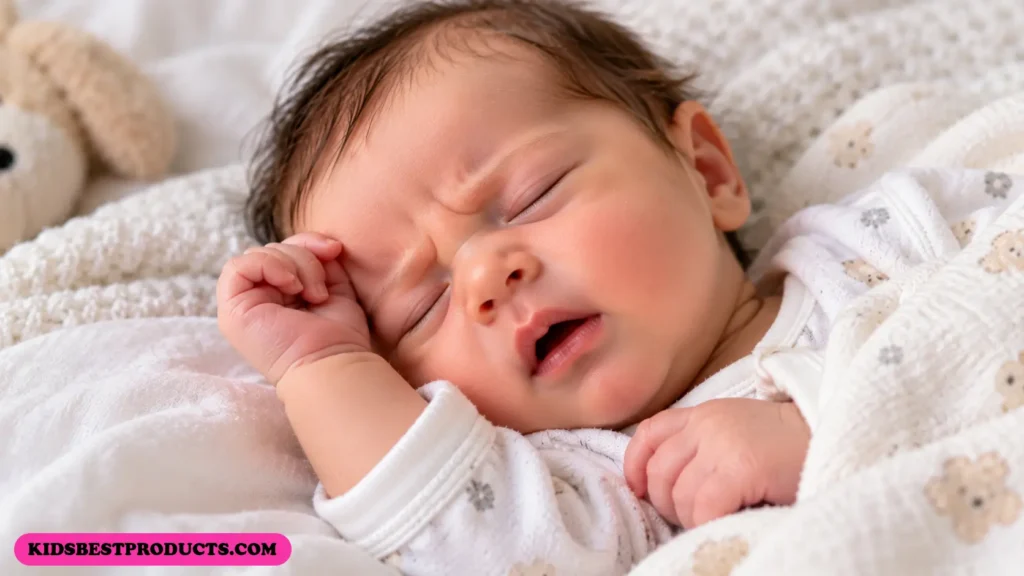
Since a nightmare is off the table at this age, a newborn who whimpers or fusses in their sleep is almost always reacting to something physical, like hunger, gas, the startle reflex, or simply moving between sleep stages. Newborns cycle through those stages every 40 to 60 minutes, compared to roughly every 90 minutes in adults, so brief stirring and fussing are a normal part of how they sleep. For the full list of causes and when it’s worth stepping in, see our guide on why babies cry in their sleep. Whatever is behind the fussing, keep the usual safe sleep positions in place.
Can Babies Have Nightmares? When Do Babies Start Having Nightmares
This is a different question from the newborn one, and it deserves its own answer. Do babies have nightmares at some point, even if newborns don’t? Yes, just not on the newborn timeline. As a baby’s brain develops memory, imagination, and language over the following months, the ingredients for an actual nightmare start coming online. Most sources place the earliest realistic window somewhere between 18 months and 2 years old, once a toddler can hold onto an image or idea well enough for it to follow them into sleep. Whether you’re asking can babies have nightmares or do babies have bad dreams, the honest answer is that both become possible around the same age, and get noticeably more common between ages 3 and 5, right as imagination and vocabulary both take off.
What Do Babies Have Nightmares About?
Before a child has the words to describe a dream, it’s hard to know the exact content. Once toddlers can talk about it, common nightmare themes involve being separated from a parent, loud or sudden noises, animals, or imaginary threats like monsters, the same fears showing up in their waking imagination at that age. For a toddler who isn’t fully verbal yet, waking up clearly frightened and reaching for you can be one sign of a bad dream, though it’s hard to know for certain until they can describe it.
When Do Babies Start Dreaming, Separate From Having Nightmares
When do babies start dreaming is actually a slightly different question than when nightmares start. Researchers believe some form of simple dreaming, more like disconnected images or sensations than a full story, may begin earlier, but true narrative dreaming with characters and a plot is generally tied to the same language and memory milestones as nightmares, so it’s usually placed in a similar window, from roughly age 2 onward. Before that, a baby’s brain is active during REM sleep, but not in a way that produces the kind of dream an older child could describe.
Nightmares vs. Night Terrors
Parents often mix these two up, and they’re not the same thing.
A nightmare happens during lighter REM sleep, usually later in the night. The child fully wakes up, is upset, and can often describe what scared them. A night terror happens during deep, non-REM sleep, typically within the first few hours after bedtime. A child having a night terror may cry out or thrash but doesn’t actually wake up, and won’t remember it in the morning. Night terrors can happen in toddlers younger than the age nightmares typically start, which adds to the confusion when a baby cries out suddenly at night.
Frequently Asked Questions
The Bottom Line
Can newborns have bad dreams? Not in any real sense, since the imagination and memory a nightmare needs simply aren’t built yet at this age. What looks like a bad dream is almost always something physical: hunger, gas, a startle reflex, or a normal shift between short newborn sleep cycles. Real nightmares are a later development, generally starting somewhere between 18 months and a few years old, once memory, imagination, and language have had time to grow.
This article is for general information and isn’t a substitute for medical advice. Talk to your pediatrician if nighttime crying seems unusual, persistent, or paired with other symptoms.

Newsletter Signup
Subscribe to our weekly newsletter below and never miss the latest product or an exclusive offer.