Baby Soft Spot (Fontanelle): What’s Normal and When It Closes
Maybe you just felt something give slightly under your fingers while washing your baby’s hair, and froze. Maybe you noticed a faint pulsing at the top of their head and immediately assumed the worst. Or maybe someone mentioned the word “fontanelle” and you realized you have no idea what that actually means or why your baby has one.
Nobody hands you a manual for this at the hospital, and the idea of a gap in a newborn’s skull sounds a lot scarier than it actually is. Here’s exactly what a baby soft spot is, why it’s there, and the two situations that genuinely deserve a call to your pediatrician.
A baby soft spot, or fontanelle, is a normal gap between the bones of the skull. The smaller one at the back of the head usually closes by 1 to 2 months old. The larger one at the top typically closes somewhere between 7 and 19 months, with the full normal range stretching from 4 to 26 months. A soft spot that’s flat or gently curved and pulses slightly is healthy. One that’s sunken in, or one that stays firm and bulging even when your baby is calm, are the two signs worth getting checked.
Why Your Baby Has a Soft Spot in the First Place
A fontanelle is a gap between the bones of your baby’s skull, covered by a tough membrane rather than bone. It isn’t a hole, and it isn’t fragile in the way it sounds. The membrane is dense enough to protect the brain underneath during everyday handling, feeding, and even the usual bumps of babyhood.
How It Helps During Birth
The soft spot lets the skull bones overlap slightly as your baby moves through the birth canal. Without that gap, a baby’s head simply couldn’t mold enough to pass through safely.
How It Supports Brain Growth
Since a baby’s brain roughly doubles in size in the first twelve months, the skull needs somewhere to expand into. The soft spot gives the skull that room, closing gradually only once the fastest phase of brain growth has slowed down.
Six Soft Spots, Though You’ll Only Notice Two
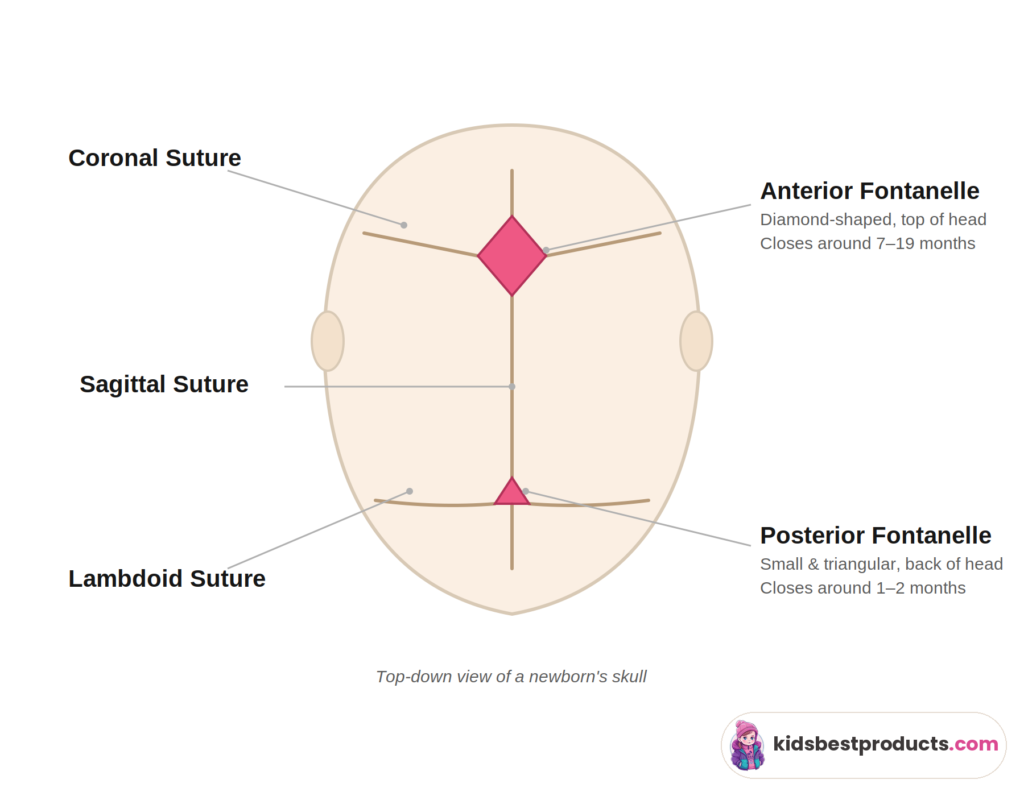
Most parents only ever hear about one, but a newborn actually has six areas where the skull bones haven’t fully joined yet. Every baby soft spot on head location matters a little differently, though you’ll only really notice two of them.
Anterior Fontanelle
The large, diamond-shaped gap on the top of the head, roughly where a hair part would be. This is the one people usually mean when they say “the soft spot.”
Posterior Fontanelle
A smaller, triangular gap toward the back of the head. It’s often barely noticeable and closes much sooner.
The other four sit along the sides of the skull and are rarely felt through your baby’s hair. They close earlier and rarely come up in conversation with your pediatrician.
1. Soft Spot Closing Timeline: Back First, Top Later
This is the question almost everyone searching for this article actually wants answered, so here’s a clear breakdown by fontanelle, covering exactly when does baby soft spot close and, just as often asked, when does baby soft spot go away completely.
|
Fontanelle |
Typical closure |
Full normal range |
|
Posterior (back of head) |
1 to 2 months |
Usually closed by 2–3 months |
|
Anterior (top of head) |
|
|
That anterior range looks wide because it is. Pediatric sources genuinely differ on the exact numbers: some say a typical closure window of 12 to 18 months, others cite 7 to 19 months as the range where 90% of babies fall. What all of them agree on is that anywhere from 4 months to past the second birthday can be perfectly normal. Your baby’s own timeline depends on genetics, growth rate, and a certain amount of ordinary variation that has nothing to do with development or intelligence.
Since a premature baby’s skull is still catching up on growth after birth, the timeline shifts too. Soft spots in premature infants often close later than the standard range, and pediatricians typically track this using your baby’s adjusted age rather than their actual birth date.
Boys and girls also differ slightly on average, with anterior fontanelles tending to close a little earlier in boys, though this is a minor trend rather than a rule.
“Parents assume the soft spot is fragile because of the name. In reality it’s one of the more resilient parts of a newborn’s anatomy during everyday handling.”
Ashley, MD
2. Touching Your Baby’s Soft Spot: What’s Actually Fine
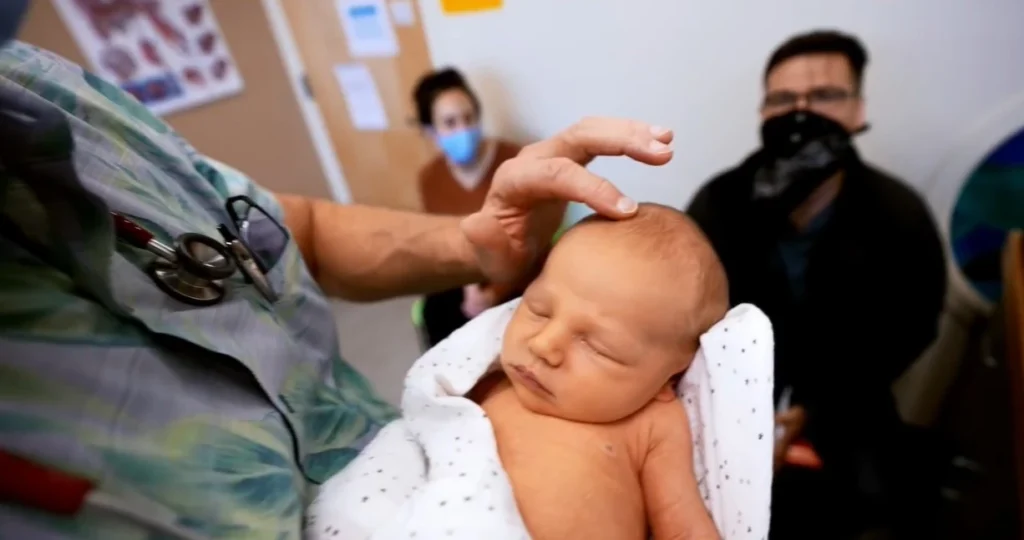
New parents worry about this constantly, and it’s almost always an unfounded worry. The membrane covering it is thick and resilient, so ordinary contact won’t hurt your baby in any of the everyday situations below.

Hair Washing and Cradle Cap
You can shampoo directly over the area with normal, gentle pressure. If your baby has cradle cap sitting right on the fontanelle, which is common, using a soft brush to loosen the flakes is safe too. Pediatric sources are consistent on this: gentle brushing doesn’t put any pressure on the brain itself.
Hats, Hands and Everyday Contact
Hats, headbands, and hair accessories pose no risk at all. The same goes for kisses, cuddles, and siblings touching the head. Typical affectionate contact is fine, and you don’t need to redirect a toddler sibling away from the top of the baby’s head out of caution.
Carriers, Car Seats and Babywearing
None of these put meaningful pressure on this part of the skull. A baby soft spot injury from ordinary daily activities is extremely rare, since the only real risk comes from deliberate, forceful pressure, which isn’t something that happens by accident during normal care.
Baby Soft Spot Pulsing: What It Means
If you’ve noticed a faint pulsing or throbbing at your baby’s soft spot, especially when they’re calm, that’s your baby’s own heartbeat. Because there’s no bone directly over the fontanelle, blood flow close to the surface of the skin becomes visible in a way it wouldn’t be anywhere else on the head. It’s one of the more unsettling things to discover by accident and one of the least concerning once you know what it is.
Bulging Soft Spot: When It’s Normal and When to Worry
This is where a lot of the anxiety comes from, and it’s also where a lot of general advice online oversimplifies things. The truth has an important nuance to it.
A brief bulge is often completely normal, and it usually shows up in a handful of predictable moments.
- crying
- coughing
- straining to have a bowel movement
- lying flat
In all of these situations, pressure inside the head rises slightly for a moment, and the area can puff out as a result. Once your baby calms down, sits upright, or stops straining, it should go back to looking flat or gently curved.
Staying firm and bulging while your baby is calm, quiet, and upright is different, and it’s worth medical attention, particularly alongside other symptoms.
When to call the doctor vs. go to the ER
Baby soft spot bulging: when it’s normal and when to call the doctor or go to the ER
| Situation | What to do |
|---|---|
| Bulges only during crying, coughing, or straining, and returns to normal once your baby settles | Normal |
| Persistently bulging while your baby is calm and upright, with no fever or other symptoms | Call today |
| Bulging with fever, repeated vomiting, unusual sleepiness, or a high-pitched cry | Emergency now |
| Bulging after a fall or head injury | Emergency now |
One detail that surprises a lot of parents: a bulging soft spot on its own is actually a poor predictor of serious illness. A hospital-based study of infants with fever and a bulging fontanelle found that the vast majority did not have bacterial meningitis, and most cases turned out to have benign, self-limiting causes. That said, this isn’t a reason to dismiss the symptom entirely, since the combination of signs matters more than the bulge alone. If in doubt, a same-day call to your pediatrician is always the right move.
Sunken Soft Spot: Usually a Dehydration Sign
A soft spot that looks noticeably caved in, rather than just flat, is most often a sign of dehydration. It rarely shows up alone, so look for the other signs too, like fewer wet diapers, a dry mouth, or crying without tears. Our guide to newborn dehydration signs has the full checklist and explains when it becomes urgent.
A slight dip in an otherwise well, well-fed baby isn’t automatically a red flag on its own. But if it shows up alongside other dehydration signs, especially during a stomach bug, fever, or hot weather, call your pediatrician the same day.
What If the Soft Spot Closes Too Early or Stays Open Too Long?
Early Closure
Known medically as craniosynostosis, happens when one or more of the skull’s seams fuse before your baby’s brain has finished its rapid early growth. This isn’t something you can diagnose by feel alone. Pediatricians look for it using head shape and head circumference measurements tracked over time.
Delayed closure
Where the anterior fontanelle is still open well past the two-year mark, can sometimes be linked to underlying conditions such as hypothyroidism, rickets, or certain genetic conditions. It’s far more often just a variation of normal, but it’s exactly the kind of thing your pediatrician is tracking at every visit, which is why you don’t need to monitor it yourself between appointments.
Soft Spot Size Varies More Than People Expect
There’s a genuinely wide range of normal here. The anterior fontanelle averages a little over 2 centimeters across at birth, but studies measuring hundreds of healthy newborns have found normal sizes ranging from under 1 centimeter to well over 3 centimeters. Some babies have what’s sometimes called a “quiet” one that’s barely noticeable, while others have one you can see move easily. A soft spot on the small side and one on the large side can both belong to a perfectly healthy baby.
Size also varies somewhat by ethnicity, with some research finding slightly larger averages in infants of African descent compared to infants of European descent. If your baby’s measurement seems unusually large or small compared to what you’ve read, it’s a completely reasonable thing to mention at your next checkup rather than something to worry about between visits.
A Third Fontanelle
Occasionally, a baby is born with an extra, smaller gap between the two main ones, sometimes called a third fontanelle. By itself this usually carries no real significance, though pediatricians may note it during a physical exam as one small piece of a broader picture, particularly when checking for certain genetic conditions. Most parents never notice it without a doctor pointing it out.
What Your Pediatrician Checks at Well Visits
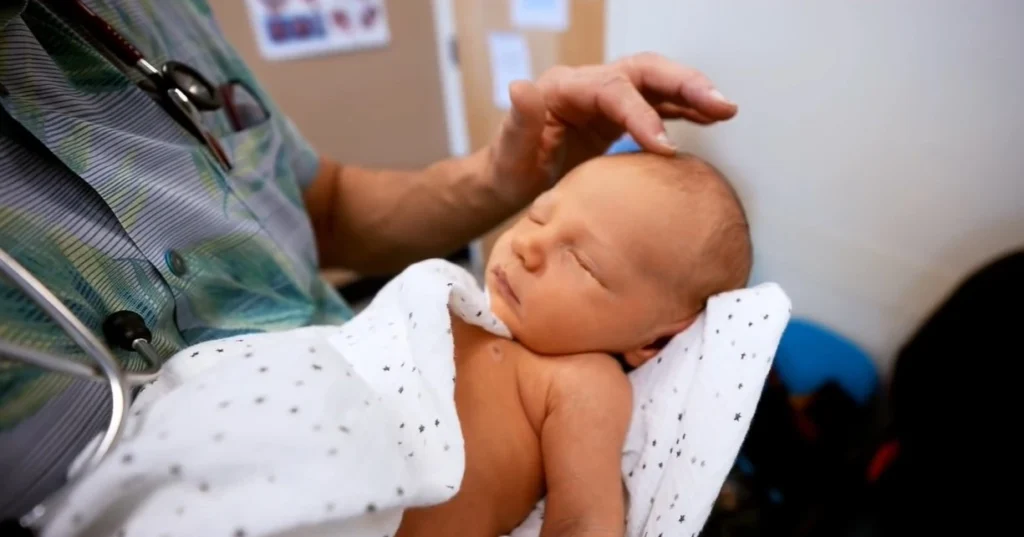
At nearly every well-child visit in the first two years, your pediatrician will gently feel your baby’s soft spot as part of the physical exam, alongside measuring head circumference and plotting it on a growth chart. This combination tells them far more than the soft spot alone ever could. It shows whether the skull is growing at a healthy rate, whether the fontanelles are closing on a reasonable timeline, and whether anything about head shape or size needs a closer look. It’s a quick, painless part of the exam, and it’s one of the main reasons these checkups matter even during the months when everything seems to be going fine.
The open fontanelle also does something few parents realize: it gives doctors a genuine window into the brain. Since there’s no bone in the way, an ultrasound probe placed directly over the soft spot can image the brain underneath, which is exactly how doctors check for concerns like bleeding, fluid buildup, or structural issues in a young infant without needing a CT scan or sedation. It’s one more reason this ordinary-looking gap is doing more work than it gets credit for.
Baby Soft Spot FAQs
The Bottom Line
A baby soft spot looks and sounds more delicate than it actually is. Flat or gently curved, pulsing now and then, and briefly bulging during crying or straining, is exactly what a healthy, normally developing baby looks like. The two situations worth a same-day call are a soft spot that stays bulging while calm, or one that looks distinctly sunken alongside signs of dehydration. Outside of those, your baby soft spot will quietly close on its own timeline sometime in the first two years.
This article is for general information and isn’t a substitute for medical advice. Always contact your pediatrician with specific concerns about your baby’s health.

Newsletter Signup
Subscribe to our weekly newsletter below and never miss the latest product or an exclusive offer.