Bassinet Weight Limit for 15 Popular Brands and When to Stop
At the last checkup the scale said 15 pounds, and now you’re looking at the bassinet and wondering how much room is left. Is the number on the label a strict rule, or more of a suggestion? Most bassinets have a weight limit of 15 to 20 pounds, and a few go up to 25. It’s a firm safety limit. Many babies have to stop even sooner, because the bassinet weight limit only applies until your baby can push up on hands and knees or roll over, whichever comes first. Below you’ll find the limits for 15 popular bassinets, what to do if your baby goes over, and which bassinets last a little longer.
Is your baby big for their age, born early, or growing fast? Ask your pediatrician which sleep space suits them right now. Don’t wait because a friend’s baby stayed in the same bassinet longer, or because your first child did. Every baby is different, and only your doctor knows how yours is growing.

Bassinet Weight Limits by Brand
We checked each manufacturer’s product page or manual in October 2026. Limits can differ between models and versions of the same brand, so always confirm with the label and manual for your own bassinet.
| Bassinet | Weight limit | Also stop when | Overnight sleep |
|---|---|---|---|
| Newton Bassinet & Bedside Sleeper | 20 lb (9 kg) | Baby pushes up on hands and knees, rolls both ways or sits up; designed for about 6 months | Yes |
| HALO BassiNest Swivel Sleeper 3.0 | 20 lb (9 kg) | Baby pushes up on hands and knees | Yes |
| Chicco Close to You and LullaGo Anywhere | 20 lb (9 kg) | Baby pushes up on hands and knees | Yes |
| Baby Delight Beside Me Dreamer | 20 lb (9 kg) | Baby pushes up on hands and knees | Yes |
| Maxi-Cosi Iora | 20 lb (9 kg) | Baby pushes up on hands and knees | Yes |
| Maxi-Cosi Starling | 20 lb (9 kg) | See the manual for movement limits | Yes |
| Milliard Bedside Bassinet | 20 lb (9 kg) | See the manual for movement limits | Yes |
| UPPAbaby Bassinet V3 | 20 lb (9 kg) | Baby pushes up on hands and knees | Only on the UPPAbaby Bassinet Stand |
| Nuna MIXX bassinet | 20 lb (9 kg) and 27 in tall | Baby pushes up on hands and knees; made for birth to 6 months | Only on the MIXX stand |
| Mockingbird Bassinet | 20 lb (9 kg) | Baby pushes up on hands and knees | Only on the Mockingbird Bassinet Stand |
| Graco Pack ‘n Play bassinet insert | 15 lb (6.8 kg) on most models | Baby pushes up on hands and knees | Yes, attached to the play yard |
| SNOO Smart Sleeper | 25 lb (11.3 kg) | Baby reaches 6 months or gets onto hands and knees | Yes |
| 4moms mamaRoo sleep | 25 lb (11.3 kg) | Baby pushes up on hands or knees | Yes |
| Arm’s Reach Mini Ezee | 25 lb (11.3 kg) | See the manual for movement limits | Yes |
| Dream On Me Karley | 25 lb (11.3 kg) | About 3 months, according to its manual | Yes |
Bassinet weight limit by brand, from manufacturer product pages and manuals, checked October 2026.
Two things stand out. Twenty pounds is by far the most common limit, and almost every brand adds a second rule about movement. For most babies, that movement rule arrives long before the weight limit does.
What’s the Typical Bassinet Weight Limit?
It depends on the type of bassinet.
- Bedside and standalone bassinets usually hold 15 to 20 pounds. Chicco, for example, says most bassinets have a 15 to 20 pound limit. Our guide to the best bedside bassinet compares the main models side by side.
- Smart bassinets sometimes go higher. The SNOO and the mamaRoo sleep are both rated to 25 pounds.
- Stroller bassinets from UPPAbaby, Nuna and Mockingbird hold 20 pounds and are only approved for overnight sleep on the brand’s own stand.
- Play yard bassinet inserts are often the lowest, at 15 pounds on most Graco Pack ‘n Play models.
- Moses baskets vary a lot, and many have lower limits than full bassinets. Check the label.
The bassinet weight limit is rarely the first limit most babies hit. According to the WHO growth charts that the CDC recommends for babies under 2, an average 6-month-old weighs around 16 to 17.5 pounds (7.3 to 7.9 kg). See the WHO growth charts on the CDC site. By then, most babies are already rolling or starting to push up, which ends bassinet use on its own. Bigger babies are the exception, and some reach 20 pounds at 3 or 4 months.
Weight Isn’t the Only Limit
The US safety rule for bassinets and cradles, set by the Consumer Product Safety Commission (CPSC), says a bassinet isn’t intended for use beyond about 5 months, or once a baby can push up on hands and knees. You can read the CPSC’s announcement of the federal bassinet standard. That’s why nearly every label says “or until baby pushes up on hands and knees, whichever comes first.”
Stop using the bassinet when any of these happen, even if your baby is under the bassinet weight limit.
- Your baby pushes up on hands and knees, sits up or pulls up. A baby who can lift up can tip a shallow bassinet or climb over the side.
- Your baby rolls over. Bassinet sides are low, and a rolling baby can end up wedged against them. Our guide on when babies can sleep on their stomach explains rolling and safe sleep.
- Your baby runs out of room. If their head and feet touch both ends, or they keep waking up when they bump the sides, they’ve outgrown it.
For the full list of signs and a step-by-step plan for the switch, see our guide on when to move baby from bassinet to crib.
How to Find Your Bassinet’s Limit
You’ll usually find your bassinet weight limit in three places.
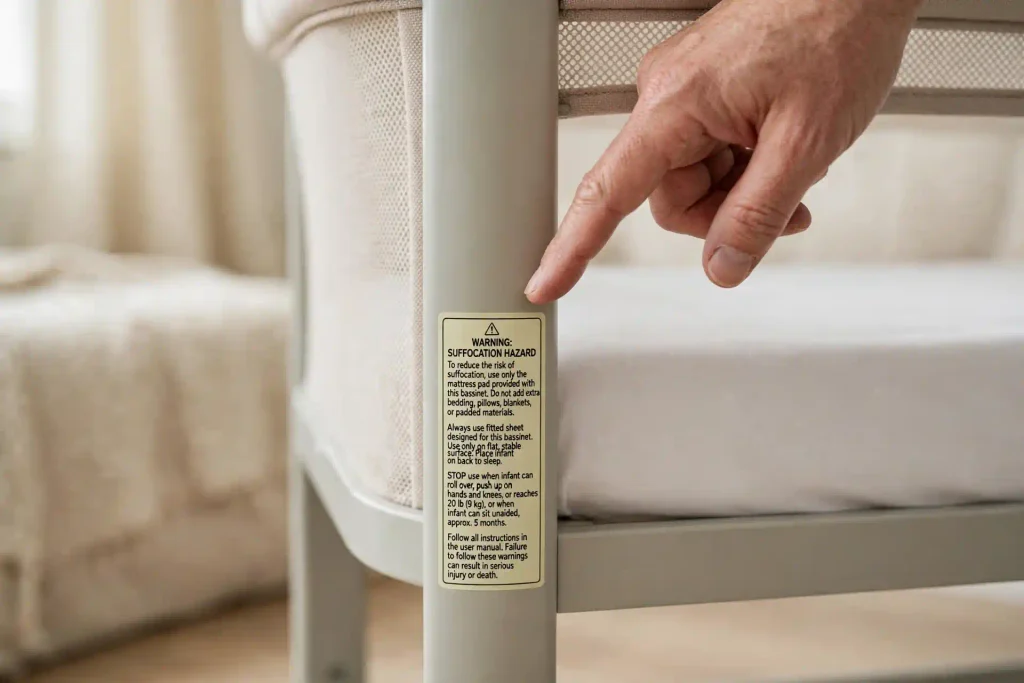
- The warning label. It’s sewn into the fabric or stuck on the frame, legs or the underside of the mattress board.
- The manual. Look for the “Warning” section near the front. If you’ve lost it, search the brand’s website for your model number, since most brands post manuals as free PDFs.
- The product page. It’s usually listed under specifications or recommended use.
If the label and the product page don’t match, follow the label on your bassinet. It applies to the exact version you own.
What Happens If You Go Over the Weight Limit?
In parent forums, a common question is whether the bassinet weight limit is a casual suggestion or a serious risk. It’s a real limit. Manufacturers test their bassinets to the US safety standard for the weight and age range on the label. Above that weight, nobody has checked that the frame, the mattress board or the stand will stay stable when a heavier, stronger baby moves around.
A heavier baby is usually also a bigger, more active baby. They sit closer to the rim, push harder against the sides, and are closer to rolling or pushing up. Those are the situations bassinets aren’t built for.
If you notice you’re a pound or two over, don’t panic. Your baby hasn’t been harmed by the nights that have passed. Just move them to a crib, mini crib or play yard for the next sleep.
Can You Remove the Legs or Lower the Bassinet?
No. It’s a common idea, and parents ask about it in forums, but taking off the legs or setting the bassinet on the floor doesn’t change the weight limit. The sleep surface and sides are the same, and the bassinet was never tested that way. Don’t add padding or a thicker mattress either. Manuals such as UPPAbaby’s specifically say never to add a pillow, comforter or extra mattress. Only use the parts that came with the bassinet, set up exactly as the manual shows.
Bassinets With a Higher Weight Limit
If you’re expecting a big baby, or yours is growing fast, a few bassinets in our chart are rated to 25 pounds: the SNOO, the 4moms mamaRoo sleep, the Arm’s Reach Mini Ezee and the Dream On Me Karley. None that we checked goes up to 30 pounds.
A higher limit doesn’t always mean longer use. The movement rules still apply, and the Dream On Me Karley’s manual says to stop at about 3 months even though it holds 25 pounds. If you want one sleep space that lasts well past 6 months, these options make more sense.
- A mini crib. It fits in many bedrooms and lasts for a year or more. See our mini crib guide.
- A play yard. The main floor of a pack and play is a safe sleep space long after the bassinet insert is outgrown.
- A full-size crib in your room. This keeps your baby close for the AAP’s recommended room sharing period. Our guide on when to move baby to their own room explains the timeline.

Pack and Play Bassinet Weight Limit
Most Graco Pack ‘n Play bassinet inserts are rated to 15 pounds, and a few newer portable bassinets, such as the one on the Pack ‘n Play Close2Baby, go up to 20 pounds. The changing table on many play yards holds more than the bassinet does, which surprises a lot of parents. Once your baby outgrows the insert, take it off and use the play yard floor instead. Graco’s manuals say to stop using the play yard itself once your child is 35 inches tall, weighs more than 30 pounds, or can climb out. Our guide to the best pack and play compares models.
Stroller Bassinets: Are They Safe for Overnight Sleep?
Some are, but only with the right stand. UPPAbaby, Nuna and Mockingbird all say their stroller bassinets are approved for overnight sleep when used on the brand’s own bassinet stand. Mockingbird adds that its older Carriage accessory is not approved for sleep. When the bassinet is clicked onto the stroller, it’s for walks, not overnight sleep. The 20 pound limit applies in both cases.
Do Bassinets Expire?
Bassinets don’t have a printed expiration date the way car seats do. Even so, an older or second-hand bassinet needs a few checks before you use it.
- Check for recalls. Search the brand and model on CPSC.gov.
- Check it meets today’s standard. The federal bassinet rule was approved in 2013 and updated again in late 2025. Inclined sleepers were banned in the US in 2022, so avoid any bassinet with a tilted sleep surface.
- Check every part. Look for cracks, loose joints, torn mesh and a mattress that doesn’t fit snugly. Get the manual for the exact model so you know its limits.
Frequently Asked Questions
The Bottom Line
Most bassinets hold 15 to 20 pounds, and a few smart and bedside models hold 25. Treat the number on your label as a firm limit, and remember that rolling, pushing up or running out of room ends bassinet use too, often months before the weight limit. When you’re unsure, check the bassinet weight limit on the label, then move your baby to a crib, mini crib or play yard.
This article is for general information only. Every baby is different, and it can’t replace advice from a doctor who has examined your child or the instructions for your specific bassinet. If you’re worried about your baby, contact your pediatrician.

Newsletter Signup
Subscribe to our weekly newsletter below and never miss the latest product or an exclusive offer.